

How to use AI and LinkedIn optimisation to support your job search
The job market is more competitive than ever. Economic uncertainty, shifting employer expectations, and rapid technological change mean candidates need every advantage to stand out. At the same time, employers are under pressure to attract and retain top talent in a landscape that’s evolving at speed. Against this backdrop, the Chartered Institute of Marketing (CIM) Greater London Region hosted its latest CIM Social on 26 November, kindly hosted in partnership with Hays, to explore two critical topics: the role of AI in recruitment, and how to optimise your LinkedIn profile to support job hunting.
AI adoption in recruitment
While AI adoption is growing in the recruitment process, 70% of organisations remain uncertain about increasing its use for evaluating job applications in the future, as found by Hays research. In the evening’s opening presentation, Verity Slade from Hays, said that interestingly public sector organisations are slightly more likely than private sector ones to use AI for application screening.
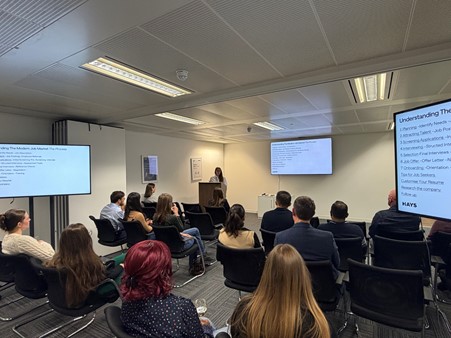
For candidates, AI can be a powerful tool to craft a CV, search for jobs, engage with peers in their network, and engage with relevant content on social media. AI can be used to help finetune your CV and optimise your CV for searches, but Verity warned not to forget to proofread everything generated using AI. Candidates should be aware of potential AI hallucinations where information may not be accurate, and not to forget to be true to your own authentic voice.
When asked about the impact of AI on the quality of candidates coming through the recruitment process, marketing employers reported mixed results, with 14% receiving better quality candidates, 14% received poorer quality candidates, and 29% finding no difference.
The key takeaway? “Employers and applicants must ensure they’re using AI as a supporting tool, not as a solution – the human touch will remain necessary for success.”
Optimise your LinkedIn to increase your visibility
With over 1 billion members, recruiters are using LinkedIn and targeted searches more than ever before to find potential candidates, and this trend is accelerating. Margaret Buj, interview coach and talent acquisition manager, shared key insights into how to optimise your LinkedIn profile to make yourself more visible to recruiters.
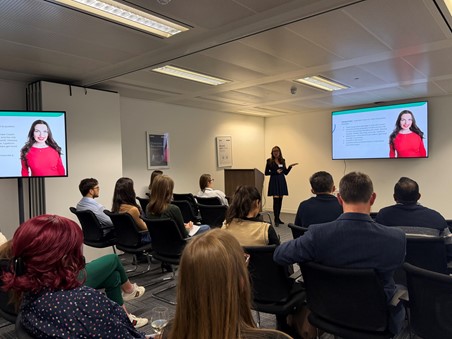
AI-powered matching and keyword optimisation have become essential for efficiency. To show up in recruiter searches, you need to optimise every section of your profile and there are four key areas that significantly impact your visibility on LinkedIn: your headline, the skills you list, your level of activity, and your connections. As recruiters increasingly utilise filters and keyword searches to find candidates, the more optimised your profile, the more visible you become.
- Your photo: a professional headshot means you are 13x more likely to be considered for job opportunities
- Your headline: you have 220 characters to capture attention and appear in recruiter searches, so make every word count
- Your about section: this is often an underused section of your profile on LinkedIn but is a great place to showcase the results you have delivered in your roles
- Your experience: use this space to tell a clear, concise story of your professional growth and impact with a focus on results, not just responsibilities
- Your skills: this section is keyword gold – LinkedIn uses it to match you with recruiter searches so make sure you prioritise your top skills, keep it updated and use role-specific skills related to your search
AI and LinkedIn optimisation are powerful tools for navigating today’s competitive job market. Use AI to enhance – not replace – your efforts, and make sure your LinkedIn profile is fully optimised to maximise visibility. And the more engaged your are on the platform, the more likely you are to appear in recruiter searches. In a world where recruiters increasingly rely on targeted searches, every detail counts.
By Annabel Elliott-Browning, Vice Chair Communications, Greater London Regional Group